Our History & Evolution
From a Bold Experiment to a National Education Movement
The story of Ananda Schools is a testament to Bangladesh’s unwavering commitment to achieving Education for All (EFA) and the UN Sustainable Development Goals (SDG-4).
In the early 2000s, despite impressive national achievements in expanding formal primary school enrollment, policy makers recognized that nearly 1.5 million children remained out of school. These were the children of the landless poor, domestic workers, street youth, and residents of remote river islands (chars) and hilly terrains. Conventional schooling could not accommodate their economic survival needs or geographic isolation.
In response, the Ministry of Primary and Mass Education (MoPME), through the Directorate of Primary Education (DPE) and with technical and financial grant partnership from the World Bank, birthed the Reaching Out-of-School Children (ROSC) initiative.
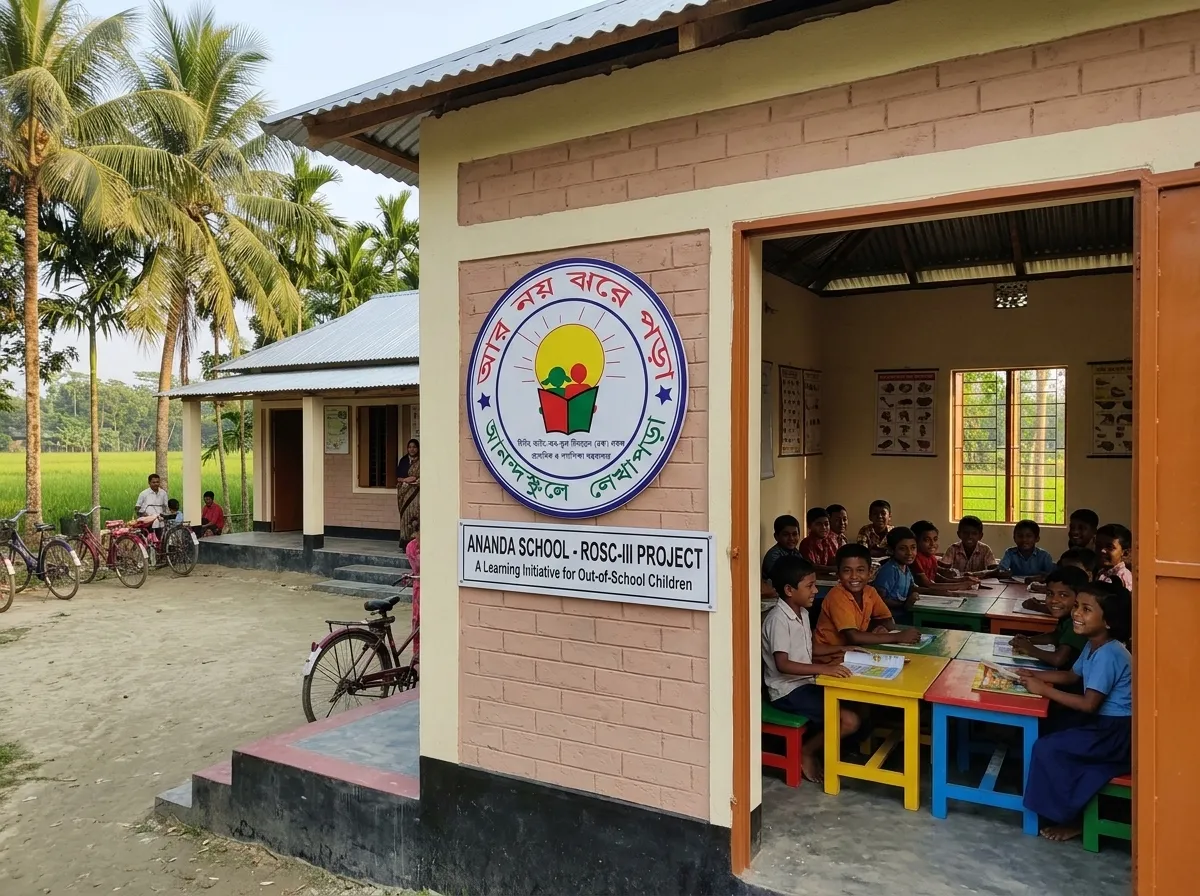
20,000+ Centers
Established across 148 disadvantaged upazilas in Bangladesh.
Historical Milestones
The Evolution of ROSC & Ananda Schools
Trace how a targeted rural intervention evolved into a comprehensive second-chance education and skills training ecosystem.
ROSC Phase I: The Inception
The Government of Bangladesh and the World Bank launch ROSC Phase I as a pilot project across 60 upazilas with high poverty and low literacy rates. The concept of "Ananda School" (School of Joy) is introduced, establishing 15,000 community-managed learning centers and proving that non-formal schools could achieve PECE pass rates exceeding 80%.
Key Achievement
Over 500,000 out-of-school children enrolled, with 52% female student participation.
Urban & Slum Expansion
Extended to working children in metropolitan slums of Dhaka, Chittagong, and Sylhet.
ROSC Phase III: Nationwide Scaling
Building on the resounding success of Phase I, ROSC-III is launched with an expanded financial commitment of $130 million. The project scales up to 148 upazilas across 64 districts, establishing over 20,000 new Ananda Schools and introducing enhanced teacher training, bi-annual learning assessments, and student stipends distributed via mobile banking.
Pre-Vocational Training & Emergency Support
ROSC-III expands its mandate beyond primary education. It launches 3-month and 6-month pre-vocational enterprise training (tailoring, electronics, mobile maintenance, beauty care) for older out-of-school youth aged 15+. Simultaneously, ROSC-III provides emergency psycho-social and learning support for displaced Rohingya refugee children in Cox's Bazar and Bandarban.
Youth Empowerment
25,000+ older youth graduated with certified market-relevant vocational skills.
Sustainable Mainstreaming
Over 690,000 students successfully integrated into mainstream secondary schools.
Sustainable Community Hubs
Today, the pedagogical innovations, teacher training manuals, and community governance frameworks developed under ROSC-III serve as a foundational blueprint for national non-formal education policy in Bangladesh, continuing to inspire global second-chance educational initiatives.