ROSC-III Project
Reaching Out-of-School Children Phase III (ROSC-III)
The ROSC-III Project is a flagship educational intervention aimed at reducing primary school dropout rates and integrating disadvantaged youth into mainstream educational and vocational pathways.
Implemented by the Directorate of Primary Education (DPE) under the Ministry of Primary and Mass Education (MoPME), and backed by a $130 million International Development Association (IDA) credit from the World Bank, ROSC-III expanded second-chance education across 148 remote upazilas and selected urban slums in Dhaka, Chittagong, and Sylhet.
Relaunched in 2026: The New ROSC-III Era
Following the successful conclusion of ROSC-II in 2022, the Government of Bangladesh and the World Bank have officially relaunched and expanded the initiative in 2026 under the brand new name: ROSC-III Project.
690,000+
Disadvantaged Children Benefited
20,400+
Ananda Learning Centers
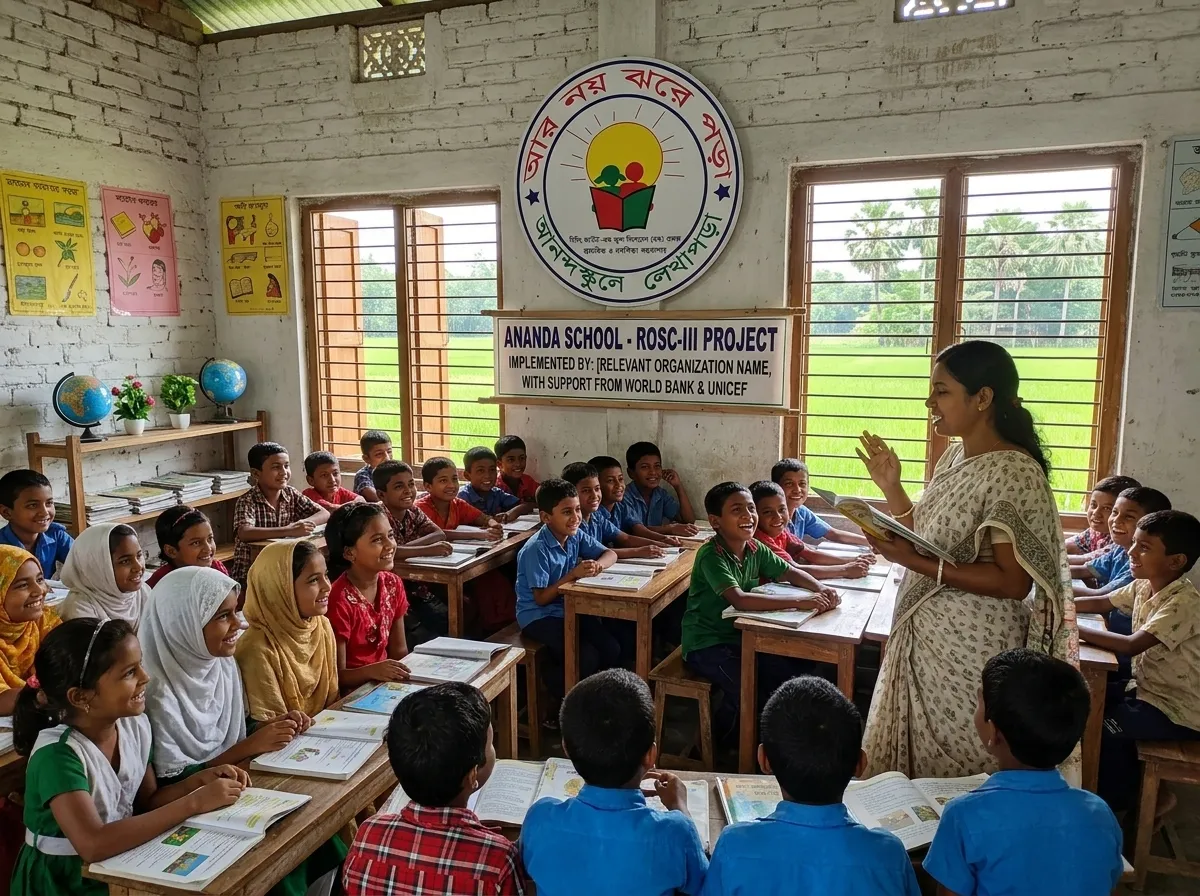
50%+ Female Participation
Prioritizing gender parity and empowering rural girl children.
How ROSC-III Starts in 2026 & Operational Governance Model
Following the conclusion of ROSC-II in 2022, the ROSC-III Project has been officially relaunched and expanded in 2026. Below is the comprehensive inception roadmap and operational governance framework.
2026 Inception & Launch Roadmap
In 2026, operations kick off simultaneously across 148 remote upazilas and selected urban slums in Dhaka, Chittagong, and Sylhet. Extensive community digital surveys will identify and enroll out-of-school, dropout, and ultra-poor children aged 7–14.
- Grassroots Digital Survey: Door-to-door identification of out-of-school children conducted by Upazila Education Offices and local communities.
- Establishing Ananda Centers: Setting up over 20,400 modern, child-friendly Ananda Learning Centers within safe walking distances in rural communities.
- Recruiting Local Teachers: Prioritizing the recruitment of educated local women (minimum HSC qualification) as center teachers with specialized pedagogical training.
Operational Governance Framework
Every learning center operates under the direct supervision of the Directorate of Primary Education (DPE) and the World Bank. To guarantee transparency and accountability, a decentralized community governance framework empowers local stakeholders.
- Community Ownership (CMC): An elected 7-to-9 member Center Management Committee (CMC)—comprising local parents, community elders, and education officials—manages center operations.
- Zero-Fee Education & Stipends: 100% free education with textbooks, uniforms, school bags, and direct mobile financial stipend transfers (bKash/Nagad) to mothers' accounts.
- Continuous Monitoring & M&E: Regular inspections by Assistant Upazila Education Officers (ATEOs) and bi-annual standardized learning competency assessments.
100% Free Second-Chance Primary Education
The core mission of the ROSC-III Project is to ensure that no disadvantaged child is left behind. Backed by the Government of Bangladesh and the World Bank, the 2026 expansion introduces modern digital learning tools and enhanced welfare support.
Project Framework
Four Strategic Components of ROSC-III
ROSC-III employs a multi-dimensional strategy that combines community governance, financial incentives, pedagogical innovations, and enterprise training.
Increasing Access to Primary Education
Establishing non-formal **Ananda Schools** in underserved rural upazilas and urban metropolitan slums. To eliminate economic hurdles for ultra-poor families, this component funds education allowances, student stipends distributed directly via mobile financial services (bKash/Nagad), and free distribution of uniforms, school bags, textbooks, and writing stationery.
- Targeted selection of poverty-prone upazilas
- Direct mobile banking stipend disbursement
Improving Quality & Retention
Focusing on teacher development and learning outcomes through the single-teacher cohort model. Teachers undergo intensive foundation training and monthly refresher workshops. Bi-annual standardized student assessments are conducted to monitor learning progress and ensure high completion rates in National Primary Education Completion Examinations (PECE).
- Continuous female teacher capacity building
- Bi-annual learning and competency assessments
Pre-Vocational Skills & Enterprise Training
Recognizing that older out-of-school adolescents (aged 15–24) require immediate livelihood support, ROSC-III introduced accredited 3-month and 6-month pre-vocational skills training in high-demand trades including garment tailoring, mobile phone maintenance, electrical wiring, beauty care, and basic computer operation.
- Market-driven trade certification for older youth
- Seed capital and toolkits for self-employment
Governance, Monitoring & CMC Ownership
Ensuring transparency and community accountability. Each learning center is governed by an elected Center Management Committee (CMC) comprising local parents, community elders, and education officials. Advanced Monitoring & Evaluation (M&E) systems track attendance and fund utilization across all 20,000+ centers.
- Decentralized Center Management Committees (CMC)
- Rigorous third-party impact evaluations
Verified Impact
Transforming Lives Across Bangladesh
Independent evaluations by the World Bank and DPE confirm that Ananda Schools under ROSC-III have successfully broken the cycle of illiteracy for hundreds of thousands of families, serving as a model for equitable education in developing nations.
Learn About BeneficiariesROSC-III Key Impact Metrics
| Metric / Indicator | Target | Achieved Result | Status |
|---|---|---|---|
| Total Disadvantaged Children Enrolled | 600,000 | 690,400+ | Exceeded |
| Female Student Share | 50.0% | 51.8% | Achieved |
| Ananda Schools Established | 20,000 | 20,450 | Completed |
| PECE Primary Exam Pass Rate | 75.0% | 82.4% | Exceeded |
| Pre-Vocational Youth Graduates | 20,000 | 25,200 | Exceeded |